Observation Notes
Sunflower Galaxy
Messier 63 or M63, also known as NGC 5055 or the seldom-used Sunflower Galaxy, is a spiral galaxy in the northern constellation of Canes Venatici with approximately 400 billion stars.
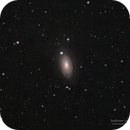
Sunflower Galaxy
Messier 63 or M63, also known as NGC 5055 or the seldom-used Sunflower Galaxy, is a spiral galaxy in the northern constellation of Canes Venatici with approximately 400 billion stars.
*Sunflower Galaxy from Everett Quebral's AstroBin gallery*
*View on AstroBin: [https://app.astrobin.com/i/352616](https://app.astrobin.com/i/352616)*
About Sunflower Galaxy
Messier 63 or M63, also known as NGC 5055 or the seldom-used Sunflower Galaxy, is a spiral galaxy in the northern constellation of Canes Venatici with approximately 400 billion stars. M63 was first discovered by the French astronomer Pierre Méchain, then later verified by his colleague Charles Messier on 14 June 1779. The galaxy became listed as object 63 in the Messier Catalogue. In the mid-19th century, Anglo-Irish astronomer Lord Rosse identified spiral structures within the galaxy, making this one of the first galaxies in which such structure was identified.
Learn more on Wikipedia: https://en.wikipedia.org/wiki/Messier_63
What Creates the Appearance
Messier 63 or M63, also known as NGC 5055 or the seldom-used Sunflower Galaxy, is a spiral galaxy in the northern constellation of Canes Venatici with approximately 400 billion stars. M63 was first discovered by the French astronomer Pierre Méchain, then later verified by his colleague Charles Messier on 14 June 1779. The galaxy became listed as object 63 in the Messier Catalogue. In the mid-19th century, Anglo-Irish astronomer Lord Rosse identified spiral structures within the galaxy, making this one of the first galaxies in which such structure was identified.
The Science Behind the Beauty
Messier 63 or M63, also known as NGC 5055 or the seldom-used Sunflower Galaxy, is a spiral galaxy in the northern constellation of Canes Venatici with approximately 400 billion stars. M63 was first discovered by the French astronomer Pierre Méchain, then later verified by his colleague Charles Messier on 14 June 1779. The galaxy became listed as object 63 in the Messier Catalogue. In the mid-19th century, Anglo-Irish astronomer Lord Rosse identified spiral structures within the galaxy, making this one of the first galaxies in which such structure was identified.
Capturing the Target
Equipment and Setup
- Telescope: Refractor or reflector with suitable focal length for the field of view
- Camera: Dedicated astronomy camera or modified DSLR
- Filters: Narrowband (Ha/OIII/SII) for emission nebulae; broadband RGB/L for galaxies and reflection nebulae
- Mount: Solid equatorial mount with accurate tracking
- Guiding: Autoguiding recommended for longer exposures
Imaging Strategy
For narrowband, gather multiple long sub-exposures in Ha, OIII, and SII. For broadband, collect balanced RGB data with sufficient luminance for detail.
Processing Techniques
- Calibration: Apply darks, flats, and biases
- Registration & Integration: Align and stack frames
- Linear Processing: Gradient removal and color calibration
- Stretching: Gradual histogram stretches to reveal faint structure
- Detail Work: Noise reduction, deconvolution, and local contrast
The Surrounding Region
This target often sits within a rich region of gas, dust, and star-forming activity. Wide fields can capture multiple catalog objects, dark nebulae, and star clusters in the same frame.
Challenges and Rewards
- Faint Structure: Demands long total integration time
- Light Pollution: Narrowband can help under bright skies
- Weather & Seeing: Stable conditions improve small-scale detail
Tips for Success
- Plan sessions across multiple nights
- Balance exposure lengths for core and faint regions
- Use masks to protect stars and highlight nebular structure
- Keep a non-destructive workflow for iterative refinement
Conclusion
Messier 63 or M63, also known as NGC 5055 or the seldom-used Sunflower Galaxy, is a spiral galaxy in the northern constellation of Canes Venatici with approximately 400 billion stars. M63 was first discovered by the French astronomer Pierre Méchain, then later verified by his colleague Charles Messier on 14 June 1779. The galaxy became listed as object 63 in the Messier Catalogue. In the mid-19th century, Anglo-Irish astronomer Lord Rosse identified spiral structures within the galaxy, making this one of the first galaxies in which such structure was identified.
Technical Data
- Object: Sunflower Galaxy
- Type: Galaxy
- Constellation: Canes Venatici